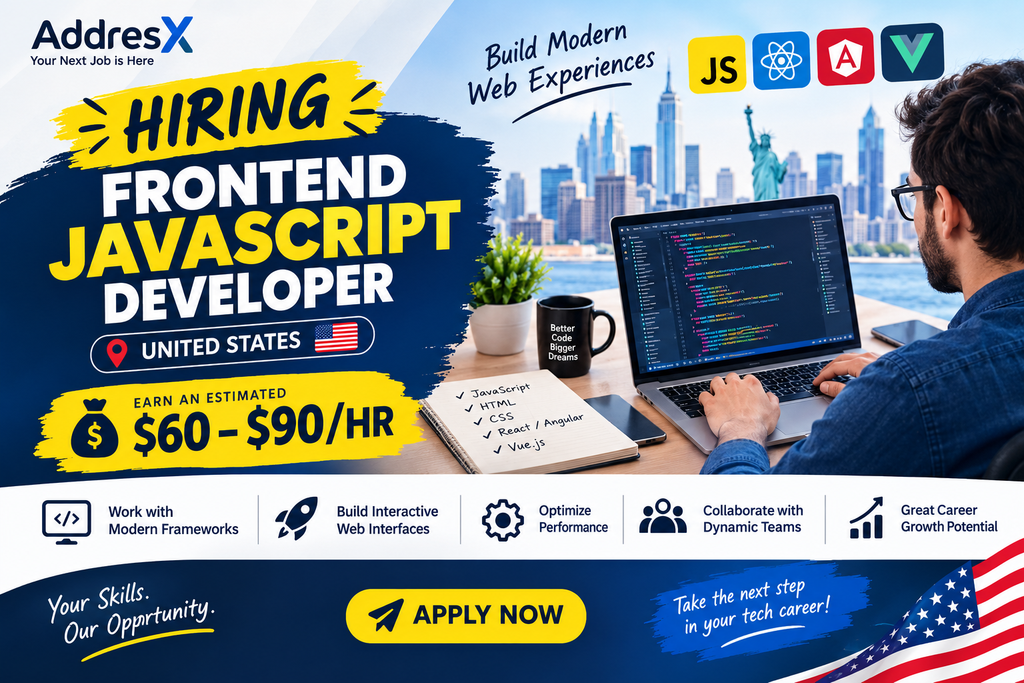
Are you passionate about building modern websites, creating interactive user experiences, and working with the latest web technologies? A Frontend JavaScript Developer opportunity could be the next step in your technology career. With an estimated pay range of $60–$90 per hour, this type of role may appeal to experienced developers looking for challenging projects, competitive compensation, and opportunities to build innovative digital products.
Frontend developers play an essential role in modern web development. They transform designs into responsive, accessible, and user-friendly websites and applications that work smoothly across desktops, tablets, and mobile devices.
If you have strong JavaScript skills, enjoy solving technical problems, and want to explore frontend development opportunities in the United States, read on to learn about the responsibilities, qualifications, skills, and potential benefits associated with this career.
Frontend JavaScript Developer Job Overview
- Job Title: Frontend JavaScript Developer
- Location: United States
- Estimated Pay: $60–$90 per hour
- Job Category: Information Technology and Software Development
- Experience Level: Typically mid-level to senior, depending on the employer
- Employment Type: Full-time, part-time, or contract, depending on the opening
- Work Arrangement: On-site, hybrid, or remote, depending on the employer
- Industry: Technology, Software Development, and Digital Services
Please note: The advertised pay range is an estimate for this job opportunity, not a verified offer from a specific employer. Actual compensation, benefits, employment type, and remote-work eligibility depend on the individual job posting.
What Does a Frontend JavaScript Developer Do?
A Frontend JavaScript Developer builds the parts of websites and web applications that users see and interact with. These professionals work with designers, backend developers, product managers, and other team members to create seamless digital experiences.
JavaScript is one of the most widely used programming languages for interactive web development. Developers often combine it with HTML, CSS, and modern frameworks to build dynamic interfaces, improve website performance, and deliver reliable functionality.
Depending on the employer, the position may involve developing customer-facing websites, business dashboards, e-commerce platforms, SaaS applications, or other web-based products.
Key Responsibilities
1. Develop Interactive Web Interfaces
Create engaging and responsive user interfaces using JavaScript, HTML, and CSS. Ensure that website features function correctly and provide a consistent experience across supported browsers and devices.
2. Build Applications With Modern Frameworks
Work with frameworks and libraries such as React, Angular, or Vue.js when required by the project. Develop reusable components that make applications easier to maintain, update, and expand.
3. Optimize Website Performance
Improve page-loading speeds, reduce unnecessary rendering, optimize JavaScript execution, and identify performance bottlenecks. A fast website can contribute to better user experiences and improved engagement.
4. Collaborate With Design Teams
Convert UI/UX designs, wireframes, and prototypes into functional web interfaces. Maintain consistency with design systems, typography, layouts, and accessibility requirements.
5. Integrate APIs and Backend Services
Connect frontend applications with REST APIs or GraphQL services. Work with backend teams to display data accurately, handle application states, and manage errors appropriately.
6. Test and Debug Code
Identify and resolve coding issues, browser compatibility problems, and interface defects. Use browser developer tools, testing frameworks, and debugging techniques to maintain application quality.
7. Maintain Code Quality
Write clean, reusable, and well-organized code. Follow established development standards, participate in code reviews, and contribute to documentation and ongoing improvements.
8. Improve Accessibility and User Experience
Develop interfaces that are accessible to users with different needs. Apply appropriate semantic HTML, keyboard navigation, responsive layouts, and accessibility best practices.
Required Qualifications
Employers may have different requirements depending on the complexity of their products and the seniority of the position. Common qualifications include:
- Professional experience in frontend development or a related software engineering role.
- Strong knowledge of JavaScript, including modern ES6+ features.
- Practical experience with HTML5 and CSS3.
- Familiarity with at least one modern frontend framework, such as React, Angular, or Vue.js.
- Understanding of responsive web design and cross-browser compatibility.
- Experience integrating APIs and working with asynchronous JavaScript.
- Knowledge of Git and version-control workflows.
- Familiarity with debugging, testing, and browser developer tools.
- Ability to communicate technical ideas and collaborate with multidisciplinary teams.
- Strong analytical thinking and problem-solving skills.
Some employers may also prefer experience with TypeScript, Next.js, automated testing, CI/CD pipelines, performance monitoring, or cloud-based development environments.
A computer science degree or related qualification may be preferred for some positions, while other employers accept equivalent professional experience, technical certifications, or a strong project portfolio.
Essential Skills for Success
To stand out in the competitive US technology job market, candidates should focus on developing both technical and professional skills.
JavaScript expertise: Understand functions, closures, promises, async/await, modules, and modern language features.
Framework knowledge: Build practical projects using the framework requested in the job description.
Responsive design: Create interfaces that adapt to different screen sizes without sacrificing usability.
Performance optimization: Understand efficient rendering, code splitting, lazy loading, and resource optimization.
Testing and debugging: Use suitable testing tools and systematic troubleshooting methods.
Communication: Explain technical decisions clearly and work effectively with designers, developers, and stakeholders.
Continuous learning: Keep up with evolving web standards, development tools, security practices, and frontend engineering trends.
A portfolio featuring functional applications, clean code, and practical examples can help demonstrate these abilities to potential employers.
Frontend JavaScript Developer Salary: $60–$90 Per Hour
One of the most attractive aspects of this opportunity is its advertised estimated hourly pay range.
| Hourly Rate | Estimated Weekly Earnings (40 Hours) | Estimated Annual Earnings (2,080 Hours) |
|---|---|---|
| $60/hour | $2,400 | $124,800 |
| $75/hour | $3,000 | $156,000 |
| $90/hour | $3,600 | $187,200 |
These figures are illustrative calculations based on 40 paid hours per week for 52 weeks. They are gross earnings before taxes, insurance, and other deductions, and they assume continuous paid work throughout the year.
Actual earnings may vary based on location, experience, technical expertise, contract terms, and whether the role is salaried or hourly. Contract developers may also need to account for unpaid leave, gaps between projects, and self-employment expenses.
Candidates should confirm the actual compensation structure directly with the hiring employer.
Where Can You Find These Opportunities?
Frontend JavaScript Developer positions may be available across a variety of industries in the United States, including:
- Software development and technology companies.
- E-commerce and online retail businesses.
- Financial technology and digital banking.
- Healthcare technology platforms.
- Digital marketing and advertising agencies.
- SaaS and cloud software providers.
- Startups and enterprise technology teams.
Remote opportunities may also be available, but candidates should check each employer’s location requirements, eligible states, working hours, and employment restrictions before applying.
Potential Benefits of the Role
Depending on the employer and employment arrangement, a Frontend JavaScript Developer position may offer several advantages.
Competitive earning potential: Experienced developers with in-demand technical skills may qualify for higher-paying opportunities.
Career development: Frontend developers can progress into senior engineering, frontend architecture, technical leadership, or full-stack development roles.
Modern technology exposure: Many teams work with evolving frameworks, development tools, and software engineering practices.
Flexible work arrangements: Some employers offer remote or hybrid positions, although these arrangements are not guaranteed.
Transferable technical skills: JavaScript, responsive design, API integration, and software testing skills can be useful across many industries.
Benefits such as health insurance, paid leave, retirement plans, and bonuses depend on the employer and whether the position is permanent or contractual.
How to Apply for Frontend JavaScript Developer Jobs
Interested candidates should prepare a professional application that clearly demonstrates their frontend development capabilities.
- Update your resume: Highlight JavaScript expertise, frameworks, relevant projects, and measurable achievements.
- Build your portfolio: Include working applications, GitHub repositories, and examples of responsive interfaces.
- Review job requirements: Confirm the required framework, experience level, location, and employment arrangement.
- Prepare for technical interviews: Practice JavaScript fundamentals, coding challenges, debugging, and frontend system design where appropriate.
- Apply through the official listing: Follow the employer’s application instructions and provide accurate information about your qualifications.
Before sharing personal information, verify the employer and application website. Never pay a recruiter for a promised job offer, and be cautious of requests for sensitive financial information before a legitimate hiring process has been established.
Final Thoughts
A Frontend JavaScript Developer career can be an excellent option for professionals who enjoy programming, designing interactive experiences, and solving real-world technical challenges. With an advertised estimated rate of $60–$90 per hour, this opportunity may be worth exploring if you have the relevant skills and experience.
Whether you specialize in React, Angular, Vue.js, or modern JavaScript development, focus on strengthening your technical foundation, building a strong portfolio, and applying to positions that match your experience.
Ready to explore your next career opportunity? Visit AddresX to discover job listings, review available opportunities, and find roles that align with your professional goals.
