Jobs →
UI/UX Designer for E-Commerce Growth: Remote Jobs Paying $30–$80 Per Hour in the USA
Job Description
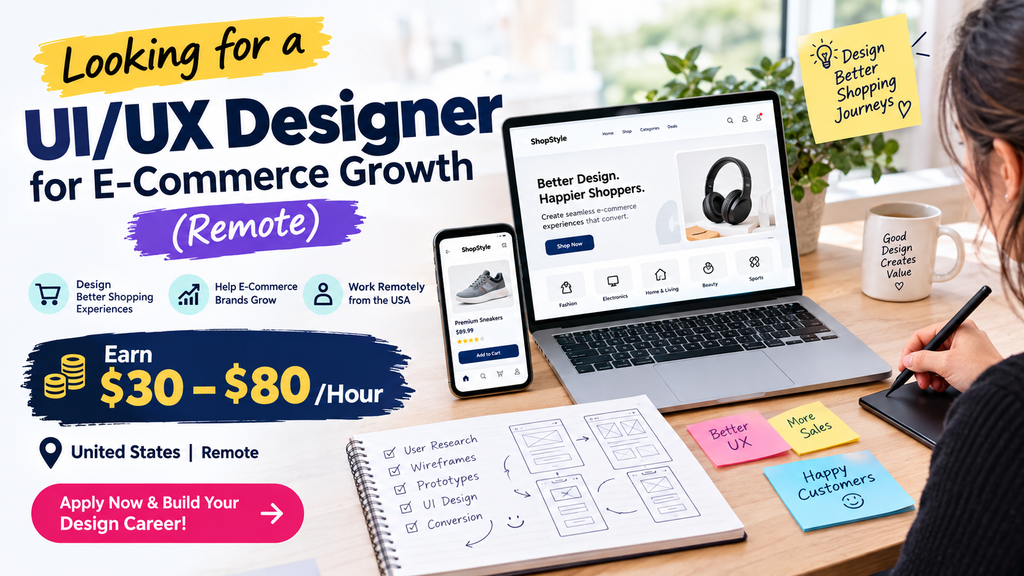
Are you a creative designer who knows how to turn an ordinary online store into a smooth, engaging, and conversion-focused shopping experience? A remote opportunity as a UI/UX Designer for E-Commerce Growth could be the career move you have been looking for.
E-commerce is growing rapidly, and businesses are constantly searching for talented designers who can help improve their websites, mobile experiences, product pages, and customer journeys. Companies do not simply need websites that look beautiful—they need digital experiences that make it easier for customers to browse, trust, and purchase.
For skilled professionals, remote UI/UX design opportunities in the United States may offer competitive compensation, with some positions advertising rates of approximately $30 to $80 per hour, depending on experience, skills, location, and the specific employer.
If you have experience with Figma, wireframing, prototyping, user research, responsive design, e-commerce platforms, or conversion optimization, this could be an exciting opportunity to take your design career to the next level.
Why UI/UX Designers Are Important for E-Commerce Growth
Think about the last time you visited an online store.
Did you find the product you wanted quickly? Was the website easy to navigate? Did the product page answer your questions? Was the checkout process simple?
These experiences are not accidental. Behind successful e-commerce platforms are teams working to understand customer behavior and improve every stage of the buying journey.
This is where a UI/UX Designer can make a major difference.
A strong designer helps create an experience that is:
- Easy to navigate
- Visually appealing
- Mobile-friendly
- Fast and intuitive
- Accessible to users
- Consistent across pages
- Focused on customer needs
For an e-commerce business, a confusing design can cause visitors to leave before completing a purchase. On the other hand, a well-designed experience can help customers discover products more easily and move through the shopping journey with less friction.
That is why companies continue to invest in talented UI and UX professionals.
How Much Can a Remote UI/UX Designer Earn?
One of the biggest reasons professionals are interested in remote design careers is the potential for competitive compensation.
Some UI/UX Designer opportunities for e-commerce and digital product teams may offer rates ranging from $30 to $80 per hour.
The actual rate can depend on several factors, including:
- Your years of professional experience
- The strength of your design portfolio
- Your UI and UX skills
- Experience with e-commerce products
- Knowledge of conversion-focused design
- Experience with Figma and prototyping
- Mobile and responsive design expertise
- The complexity of the role
- Whether the position is full-time, part-time, freelance, or contract-based
- Employer requirements and location eligibility
Designers with a strong portfolio and proven experience solving real business problems may have access to more competitive opportunities.
However, applicants should always review the job description carefully because compensation, benefits, work requirements, and eligibility can vary between employers.
What Does a UI/UX Designer for E-Commerce Growth Do?
A UI/UX Designer for E-Commerce Growth is responsible for improving how customers interact with an online store, website, or digital product.
The role may combine creativity with research, strategy, and problem-solving.
Instead of focusing only on making pages attractive, the designer may ask important questions such as:
Why are customers leaving this page?
Is the checkout process too complicated?
Can users find the right product quickly?
Does the mobile experience work smoothly?
How can the design make the shopping journey easier?
Based on these insights, the designer may create and test new design solutions.
Common Responsibilities May Include:
- Designing high-quality website and app interfaces
- Creating wireframes and user flows
- Developing interactive prototypes
- Improving product and category pages
- Optimizing navigation and search experiences
- Designing mobile-friendly shopping experiences
- Collaborating with developers and product teams
- Conducting or supporting usability testing
- Reviewing user behavior and customer feedback
- Improving checkout and cart experiences
- Maintaining design systems and UI consistency
- Supporting conversion-focused experiments
The exact responsibilities will depend on the company and the specific job opportunity.
Skills That Can Help You Stand Out
The UI/UX industry is competitive, but developing the right skills can help you build a stronger professional profile.
Figma and Design Tools
Figma is one of the most commonly used tools for creating interfaces, wireframes, design systems, and prototypes.
Experience with other design and collaboration tools can also be useful depending on the company’s workflow.
Wireframing and Prototyping
Before a website or application is developed, designers often create wireframes to organize the structure and flow of a digital experience.
Interactive prototypes can help teams visualize how users will move between screens before development begins.
User Experience Design
A successful UX designer understands more than colors and layouts.
You should be able to think about:
- User needs
- Customer behavior
- Information architecture
- Navigation
- Accessibility
- Usability
- User journeys
The goal is to create experiences that feel simple and natural.
E-Commerce Knowledge
Understanding how online stores work can be a major advantage.
Experience with product pages, shopping carts, checkout processes, search functionality, filters, and customer journeys can help you stand out when applying for e-commerce-focused positions.
Conversion-Focused Thinking
E-commerce companies often want designers who understand how design can support business goals.
This does not mean simply making buttons bigger or adding more calls to action. It means understanding the customer journey and identifying areas where users may experience confusion or friction.
A strong designer can balance business goals with genuine user needs.
Why Remote UI/UX Jobs Are Attractive
Remote work has created more flexibility for many digital professionals.
Depending on the employer and position, remote UI/UX opportunities may allow professionals to collaborate with teams without working from a traditional office every day.
Potential benefits may include:
- Flexible work arrangements
- Opportunities to work with distributed teams
- Access to digital-first companies
- Reduced commuting
- The ability to build experience across different industries
- Opportunities for freelance and contract projects
- A wider range of potential job opportunities
However, remote positions can also require strong communication, time management, and collaboration skills.
You may need to work with developers, product managers, marketers, researchers, and other stakeholders using digital communication tools.
Your Portfolio Can Be More Important Than You Think
When applying for a UI/UX Designer role, your portfolio can play a major role in demonstrating your skills.
A strong portfolio should not only display attractive screenshots.
Employers may want to understand your design process.
For each project, consider showing:
The Problem
What challenge was the business or user experiencing?
Your Research
How did you learn about the users or problem?
Your Process
Did you create user flows, wireframes, prototypes, or design alternatives?
Your Final Solution
What did the final interface look like, and why did you make those design decisions?
The Outcome
If available, include results such as improved usability, increased engagement, reduced friction, or other measurable outcomes.
Even if you are still building professional experience, you can create portfolio projects that demonstrate how you think and solve design problems.
How to Prepare for a Remote UI/UX Designer Job
Before applying, take time to prepare your professional profile.
Build a Professional Portfolio
Choose your strongest projects and present them clearly.
Quality is usually more important than the number of projects.
Update Your Resume
Highlight relevant experience, including:
- UI design
- UX design
- Figma
- Prototyping
- User research
- Responsive design
- E-commerce
- Design systems
- Collaboration with developers
- Product design
Review the Job Requirements
Every employer may have different expectations.
Read the requirements carefully and tailor your application to highlight the most relevant skills and experience.
Prepare for Portfolio Discussions
During interviews, you may be asked to explain your design decisions.
Practice talking about your process clearly. Be ready to explain the problem, your approach, the challenges you faced, and why you selected a particular solution.
Can Beginners Apply for UI/UX Designer Jobs?
Yes, but requirements vary.
Some positions may require several years of professional experience, while others may offer opportunities for junior or entry-level designers.
If you are new to the field, focus on building practical skills and a portfolio.
You can create practice projects such as:
- Redesigning an e-commerce product page
- Improving a mobile shopping experience
- Creating a checkout flow
- Designing a fashion or beauty store app
- Building a responsive online store interface
- Creating a UX case study
The important thing is to demonstrate your ability to identify problems and create thoughtful solutions.
Is E-Commerce UI/UX Design a Good Career Choice?
For designers who enjoy combining creativity with problem-solving, e-commerce UI/UX design can be an exciting career path.
Online businesses rely heavily on digital experiences, and customer expectations continue to increase. Users expect websites and apps to be easy, fast, responsive, and enjoyable to use.
This creates opportunities for skilled designers who can understand both technology and customer behavior.
The strongest professionals are often those who continue learning and adapting.
As digital products evolve, skills related to UX research, accessibility, responsive design, design systems, product thinking, and data-informed design can become increasingly valuable.
Ready to Explore Remote UI/UX Opportunities?
If you have the creativity, technical skills, and problem-solving mindset needed to improve digital shopping experiences, a UI/UX Designer for E-Commerce Growth role could be worth exploring.
Remote opportunities can vary widely, and compensation depends on the employer, experience level, responsibilities, and other factors. Some positions may advertise competitive rates ranging from approximately $30 to $80 per hour.
Before applying, review the job requirements, eligibility criteria, compensation structure, and work arrangement carefully.
A strong portfolio, relevant skills, and the ability to explain your design decisions can help you stand out from other applicants.
Your next design opportunity could involve more than creating beautiful screens. It could be your chance to help shape the digital shopping experiences that customers use every day.
Explore the available opportunity, review the requirements, and take the next step toward building your remote UI/UX design career.
Apply for this Job
Fill in the form below to submit your application