Jobs →
Multimedia Designer Jobs in the USA: Earn Up to $90K+ with Remote Image, Video & AI Skills
Job Description
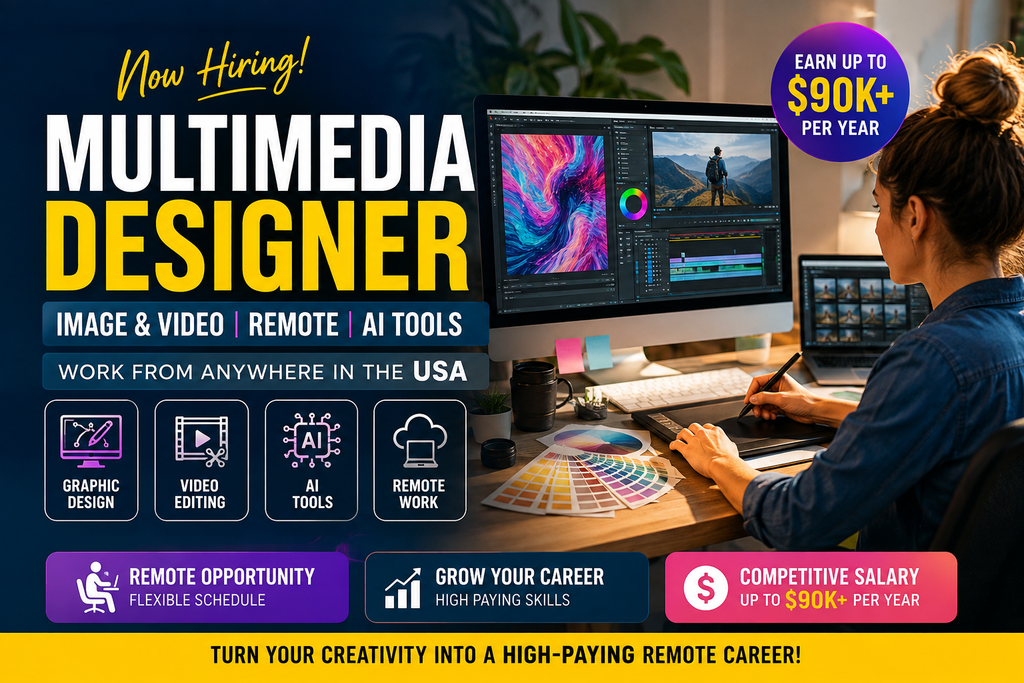
The demand for creative digital content is growing rapidly across the United States, creating exciting opportunities for Multimedia Designers specializing in image, video, and AI-powered creative tools. Businesses, marketing agencies, e-commerce brands, technology companies, media organizations, and content creators all need talented professionals who can transform ideas into engaging visual experiences.
A Multimedia Designer combines graphic design, video editing, animation, visual storytelling, and emerging artificial intelligence tools to produce high-quality digital content. With many companies embracing remote and hybrid work, skilled designers can find opportunities without being limited to a traditional office environment.
What Does a Multimedia Designer Do?
A Multimedia Designer is responsible for creating visual content across multiple digital formats. Depending on the employer, the position may involve designing social media graphics, promotional videos, advertisements, presentations, website visuals, product images, animations, and other branded content.
Typical responsibilities can include:
- Creating graphics for websites and social media
- Editing short-form and long-form videos
- Designing marketing campaigns and advertisements
- Creating thumbnails, banners, presentations, and promotional materials
- Producing product images and visual assets
- Developing motion graphics and simple animations
- Collaborating with marketing and content teams
- Maintaining brand consistency across digital platforms
- Using AI tools to improve creative workflows
- Editing and enhancing images using professional design software
- Creating visual concepts from written briefs
- Preparing content for different digital platforms
Modern Multimedia Designers are increasingly expected to understand AI-assisted creative workflows. AI tools can help professionals brainstorm concepts, generate visual ideas, remove backgrounds, improve images, create variations, assist with video production, and speed up repetitive tasks.
How Much Can Multimedia Designers Earn in the USA?
Salary is one of the biggest attractions of multimedia design careers in the United States. Compensation varies considerably depending on experience, location, industry, technical skills, portfolio quality, and job responsibilities.
A general salary range for Multimedia Designers in the U.S. can be approximately $50,000 to $90,000+ per year, while experienced professionals, specialized designers, creative leads, and professionals with strong AI, motion graphics, or video-production skills may have opportunities for higher compensation.
Entry-level professionals may start around $45,000–$60,000 annually, depending on the employer and location. Designers with several years of experience can potentially earn $60,000–$80,000+ per year, while senior-level professionals and highly specialized creatives may reach $80,000–$100,000+ annually in some markets.
Freelance and contract Multimedia Designers may also charge hourly rates. Depending on expertise and project requirements, experienced freelancers can potentially command $30–$60+ per hour, while highly specialized professionals may charge more.
Because salaries differ between companies and locations, applicants should always review the specific compensation package attached to each job.
Why AI Skills Matter for Multimedia Designers
Artificial intelligence is changing the creative industry. Instead of replacing every creative professional, AI is increasingly becoming another tool that designers can use to work faster and experiment with new ideas.
Employers may value designers who know how to integrate AI into existing creative workflows. For example, AI can help with brainstorming, image generation, background removal, image enhancement, creative variations, video concepts, transcription, captions, and other production tasks.
A designer who understands both traditional design principles and modern AI tools can potentially offer greater value to an employer.
Important skills may include:
- AI-assisted image creation
- AI video generation and editing
- Prompt writing for creative tools
- Image enhancement
- Background removal and replacement
- Automated content variations
- AI-assisted brainstorming
- Video captioning and transcription
- Creative workflow automation
However, AI knowledge should complement—not replace—fundamental creative skills such as composition, typography, color theory, storytelling, branding, and visual communication.
Essential Skills for a Multimedia Designer
Successful candidates typically need a combination of creative, technical, and communication skills.
Strong knowledge of graphic design is essential. Candidates should understand layout, typography, color combinations, visual hierarchy, branding, and composition.
Video editing skills are also highly valuable. Employers may look for candidates who can cut footage, synchronize audio, add transitions, create captions, apply effects, and prepare videos for different platforms.
Experience with popular creative software can strengthen an application. Depending on the role, employers may value familiarity with tools such as Adobe Photoshop, Illustrator, Premiere Pro, After Effects, Canva, Figma, and other image or video editing platforms.
AI experience can provide another advantage, particularly for companies producing large amounts of digital content.
Remote Multimedia Designer Jobs
Remote work has created new possibilities for creative professionals. A remote Multimedia Designer may collaborate with teams through online communication, project-management, cloud-storage, and design platforms.
Remote positions can involve:
Social Media Design: Creating Instagram, Facebook, LinkedIn, Pinterest, TikTok, and other platform-specific content.
Video Production: Producing promotional videos, advertisements, tutorials, reels, YouTube content, and short-form videos.
E-Commerce Design: Creating product images, promotional banners, advertisements, and online-store visuals.
Marketing Design: Supporting campaigns with graphics, videos, landing-page visuals, email graphics, and promotional materials.
Brand Design: Maintaining consistent visual identity across multiple channels.
Remote designers should be comfortable managing deadlines independently, communicating clearly with team members, receiving feedback, and organizing multiple projects.
Education and Qualifications
A degree in graphic design, multimedia design, visual communication, digital media, animation, or a related field can be beneficial, but it is not always mandatory.
For many creative positions, a strong portfolio can be just as important as formal education.
Your portfolio should demonstrate different types of work, such as:
- Graphic design projects
- Social media campaigns
- Video editing
- Motion graphics
- Brand identity projects
- Product visuals
- AI-assisted creative projects
- Website graphics
- Advertising creatives
A well-organized portfolio allows employers to quickly evaluate your creativity, technical ability, design style, and versatility.
How to Stand Out When Applying
Competition for creative jobs can be strong, so applicants should focus on demonstrating measurable skills rather than simply listing software names.
Instead of writing only “video editing,” show examples of videos you created.
Instead of simply mentioning “graphic design,” showcase campaign graphics, advertisements, social media designs, or branding projects.
Applicants should also keep their resumes concise and relevant. Highlight experience that directly matches the position and include keywords such as Multimedia Designer, Graphic Designer, Video Editor, Motion Graphics, AI Tools, Visual Content, Adobe Creative Cloud, Digital Media, and Remote Design when they genuinely describe your skills.
Future of Multimedia Design Careers
The future of multimedia design is increasingly connected to technology, social media, video content, e-commerce, and artificial intelligence.
Companies need more visual content than ever before. Social media platforms require constant creative assets, businesses use video to communicate with customers, and brands depend on strong visual identities to compete online.
This creates opportunities for designers who continuously develop their skills.
Professionals who combine graphic design + video editing + motion graphics + AI tools + marketing awareness can position themselves for a broader range of opportunities.
Start Your Multimedia Design Career
If you’re a creative professional in the United States looking for a career that combines image design, video production, digital creativity, and AI technology, Multimedia Designer positions can be an excellent career path.
Whether you’re starting your career or already have professional experience, building a strong portfolio, learning modern creative technologies, and understanding current digital-content trends can help you compete for opportunities.
The most successful Multimedia Designers are not simply people who know how to use design software. They are visual problem-solvers who understand how to turn ideas into content that captures attention, communicates a message, and supports business goals.
With remote opportunities expanding and AI becoming an increasingly important part of creative workflows, now can be a valuable time to develop your multimedia design skills and explore opportunities in the U.S. market.
Apply for this Job
Fill in the form below to submit your application